Patios & Walkways in Baltimore
A paver patio or stone walkway lasts only as long as the compacted base under it, so most of the work happens below grade. Solomon Construction & Remodeling builds paver patios with fire pits and seat walls, and flagstone walkways set in mortar, in Baltimore City, Baltimore County and nearby areas. We dig out, compact a gravel base and pitch it away from the house before any stone goes down.
5.0 on Google (24 reviews)Updated October 2026
What the job includes
- Paver patios with built-in fire pits and curved seat walls
- Flagstone walkways and front entries set in mortar
- Excavation and a compacted gravel base sized for the soil and use
- Patios pitched away from the house so rain doesn't pond or run toward the foundation
- Edge restraints and filled joints so pavers stay where they're set
- Layout planned around doors, steps, downspouts and planting beds
What does a patio or walkway project include?
A Solomon patio or walkway job covers layout, excavation, base, stone and cleanup. We mark the shape with you, dig out the soil to the right depth, build and compact a gravel base, set the pavers or flagstone, and finish the joints and edges. Fire pits, seat walls and steps are built on the same base as part of the job.
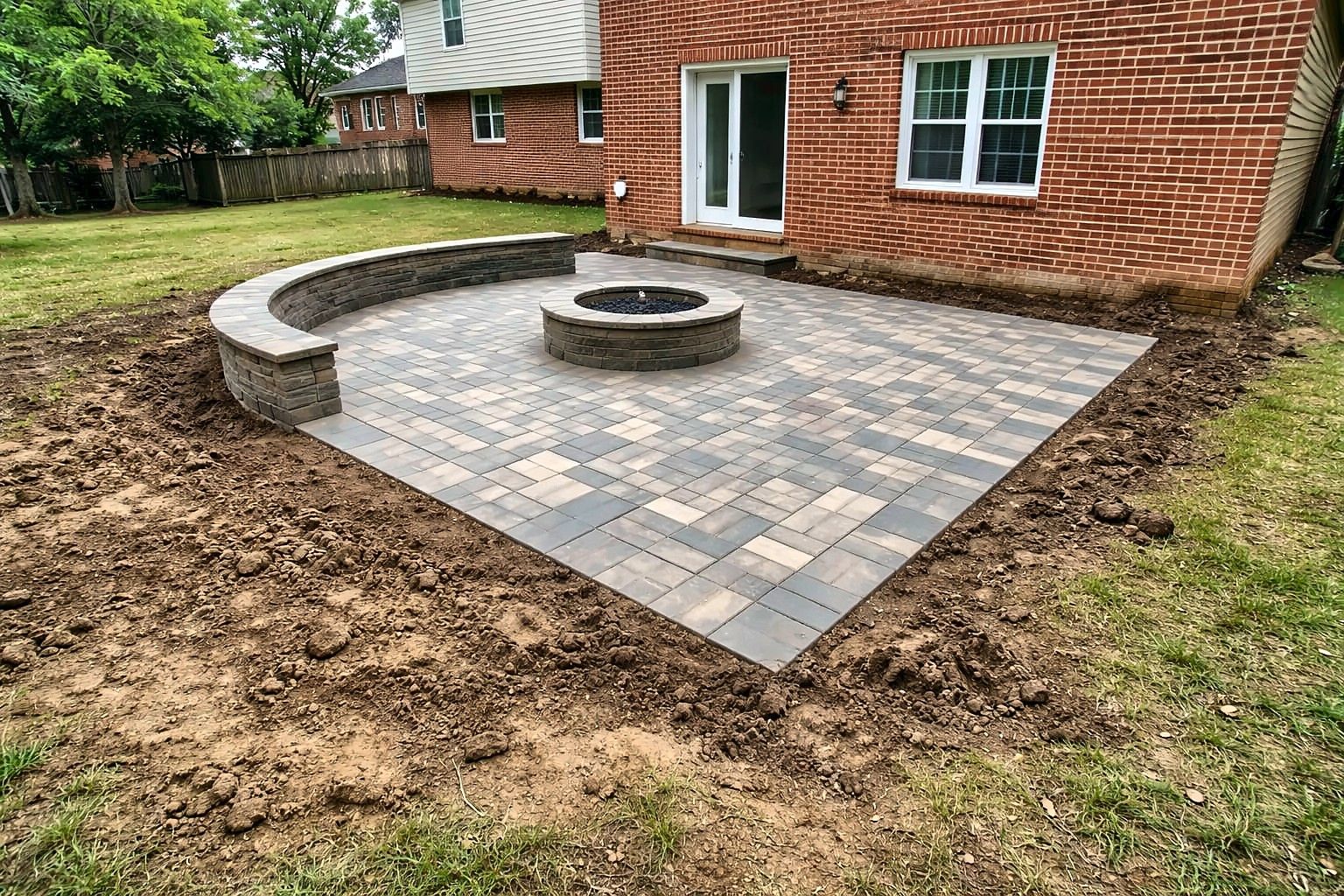
Our patio and walkway work so far includes a paver patio with a fire pit and seat wall, and a flagstone walkway at a front entry. The base and drainage work described below is what decides whether a patio still looks right after a few winters.
How is the base for a paver patio built?
The base is a layer of compacted crushed stone under the pavers, and it’s the most important part of the patio. We dig out topsoil and soft ground, then place crushed stone in layers and compact each one with a plate compactor instead of dumping it all at once. A thin bedding layer goes on top, screeded flat at the final pitch, and the pavers are set into it.
Many yards around Baltimore have clay soil that holds water and moves as it freezes. A good base keeps that movement from reaching the surface. We dig deeper where the patio will carry more weight or where the ground is soft, and we’ll tell you at the estimate if we see drainage problems that need to be solved first.
How are fire pits and seat walls built into a patio?
They’re built on the same compacted base as the patio and laid out with it, so the paver pattern, the fire pit and the wall all line up. Our paver patio project includes a built-in fire pit at the center and a curved seating wall around it, behind a brick house, with the wall sitting on solid base rather than loose soil.
Once the pavers are set, we install edge restraint around the perimeter so the field can’t creep outward, sweep joint sand into the gaps and compact the surface. The joints lock the pavers together so the patio acts as one surface instead of loose blocks.
How is a flagstone walkway set in mortar?
A mortared flagstone walkway sits on a stable concrete base, with each stone bedded in mortar and the joints pointed. The flagstone walkway we built at one front entry is gray stone set in mortar beside a garden bed. The concrete base matters, because cracks in the base will show up in the joints.
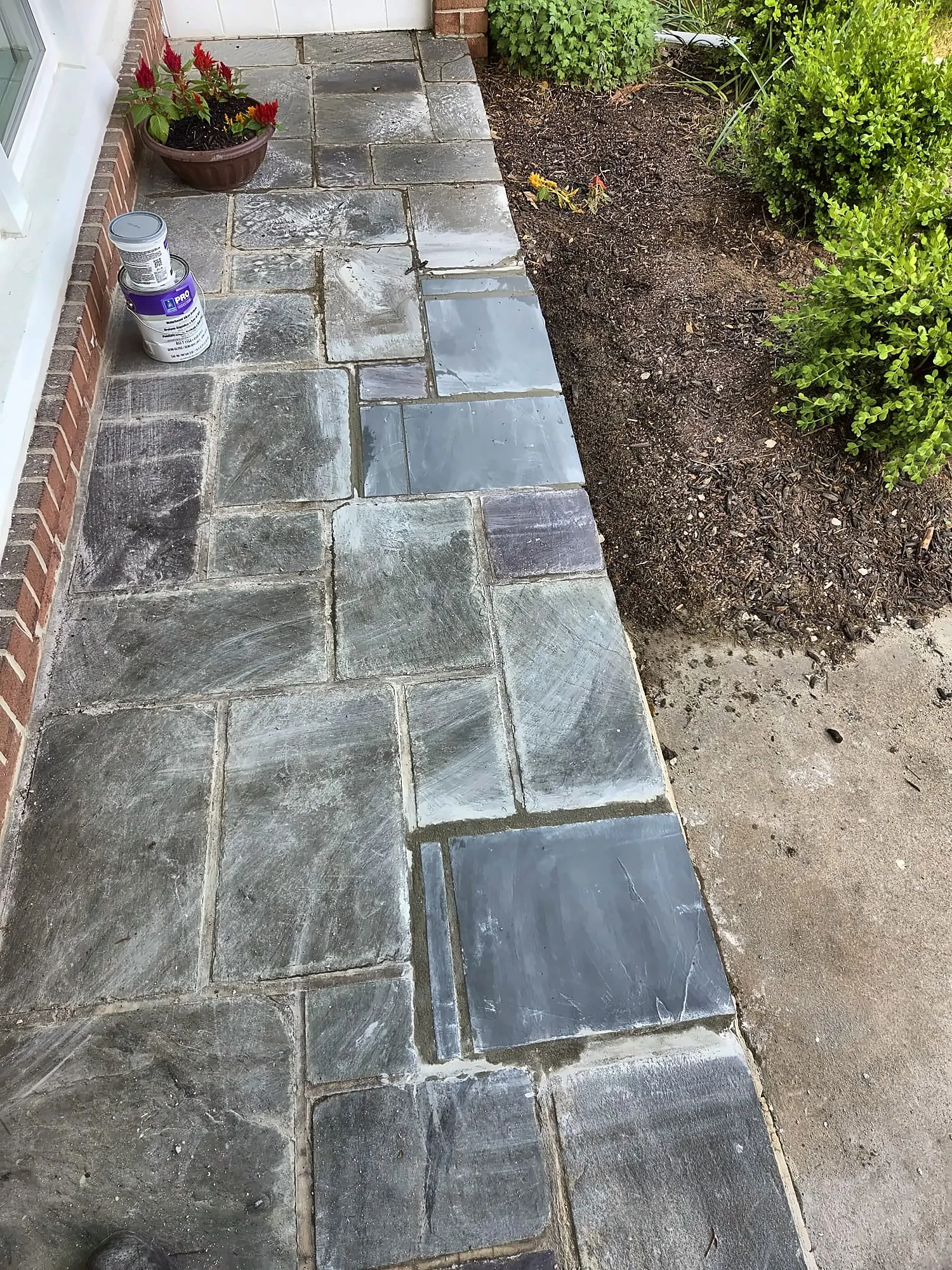
We lay out the stones dry first to get a good fit with even joints, then set each one in a full mortar bed and point the joints. The walkway is pitched slightly so rain sheds off the surface rather than sitting on it.
How do you handle drainage around a patio?
Every patio and walkway we build is pitched so water runs away from the house. A patio is a large hard surface, and if it’s flat or tilted the wrong way it will push rainwater toward the foundation, which is a common cause of wet basements.
Before we dig, we check:
- Downspouts. Where they discharge and whether they need to be extended past the patio.
- Existing grade. Which way the yard already drains, so the patio works with it.
- Basement windows and doors. So the new surface doesn’t direct water into a window well or under a door.
- Neighboring lots. Especially on rowhouse and townhouse yards, where water needs somewhere to go.
What affects the cost of a patio or walkway?
Size, stone and what has to come out of the ground set most of the cost. A small paver patio on firm soil is mostly base and stone; a large one on soft clay needs deeper excavation and more crushed stone. The other main drivers:
- Material. Pavers on a gravel base, or flagstone set in mortar over concrete.
- Excavation. How much soil comes out, and whether it has to be hauled by hand from a rowhouse yard.
- Features. Fire pits, seat walls and steps add block, base and labor.
- Pattern and shape. Curves and borders mean more cutting than a straight rectangle.
- Drainage. Downspout extensions or regrading to move water away from the house.
- Old surfaces. Breaking up and hauling away an old concrete patio or walk.
- Permits and review. City paving permits, historic review or Critical Area limits.
We give a written price after we’ve looked at the grade, soil and access.
Can a patio be planned with a deck, steps or a fence?
Yes, and planning them together is easier than fitting one around another later. A walkway might lead to new front or rear steps, a patio might sit at the bottom of a new deck, and a backyard patio is often paired with a privacy fence. Laid out together, the heights, steps, gates and drainage all line up.
What homeowners say
“I had a great experience with Solomon Construction and Remodeling. They did an excellent job renovating my bathroom, and I’m very happy with how everything turned out. The quality of the work was excellent, they paid attention to the details, and the whole process was handled professionally. The team was reliable, respectful, and easy to work with. They truly cared about doing the job right, and the finished bathroom looks amazing. I would definitely recommend Solomon Construction and Remodeling to anyone looking for quality remodeling work. Great job from start to finish!”
“I’m very happy with the overall experience with Solomon Construction & Remodeling. Their team seems dedicated to providing quality work and making sure customers are satisfied. I appreciate their professional approach, attention to detail, and commitment to delivering great results. It’s always nice to see a company that values its customers and takes pride in its work. I would definitely recommend Solomon Construction & Remodeling to anyone looking for reliable construction and remodeling services.”
“Highly recommend this company. They do excellent work and are very knowledgeable when it comes to decks, kitchens, and bathroom renovations. Everything is handled professionally, the workmanship is clean, and they pay attention to the details that make a big difference in the finished project. If you’re looking for a reliable general contractor for a deck, kitchen remodel, bathroom renovation, or other home improvement project, they’re definitely worth calling.”
Patios & Walkways: common questions
Pavers or flagstone, which is better for a patio?
Both work well, and the choice is mostly about look and how the stone is set. Pavers are uniform, come in many colors and patterns, and can be lifted and reset if something settles. Flagstone has a natural, irregular look and is often set in mortar over a concrete base for a solid, permanent surface.
Why does the base matter so much?
The base is what keeps a patio flat. Pavers or stone set on poorly compacted soil will sink, tilt and heave as the ground freezes and thaws through Maryland winters. A properly dug and compacted gravel base spreads the load and lets water drain through instead of sitting under the stone.
Can you add a fire pit or seat wall to a patio?
Yes. We've built a paver patio with a built-in fire pit and a curved seating wall around it. Fire pits and seat walls are easiest to build at the same time as the patio, because they sit on the same base and the layout can be planned together. Check your local rules on backyard fires before planning one.
Do I need a permit for a patio or walkway in Baltimore?
In Baltimore City, likely yes: the City lists walkways and other paving as permitted work and did not adopt the code exemption for sidewalks and driveways. In Baltimore County, patios and walkways on a historic or landmark property need Landmarks Preservation Commission review. In Anne Arundel, retaining walls over 24 inches need a permit, and walkways count toward Critical Area lot coverage. Confirm for your address.
How do you keep water from running toward the house?
We set a gentle pitch into the base so the finished surface slopes away from the foundation. We also look at where downspouts discharge and where the yard already drains, so the patio doesn't become a dam or send water into a basement window well.
Permit offices in our service area
- Baltimore City: Baltimore City Department of Housing & Community Development (DHCD) - Permits & Inspections (One Stop Shop)
- Baltimore County: Department of Permits, Approvals and Inspections (PAI)
- Howard County: Department of Inspections, Licenses and Permits (DILP)
- Anne Arundel County: Department of Inspections and Permits - Permit Center
Permit rules differ by jurisdiction and change over time. Confirm requirements for your address with the office above.
Tell us what you need done.
Estimates are free. Text a few photos to the number below and we can usually tell you what the job involves before we even come out.
Sun–Thu 8am–8pm · Fri 8am–4pm · Sat closed